Designing the conditions for precinct success
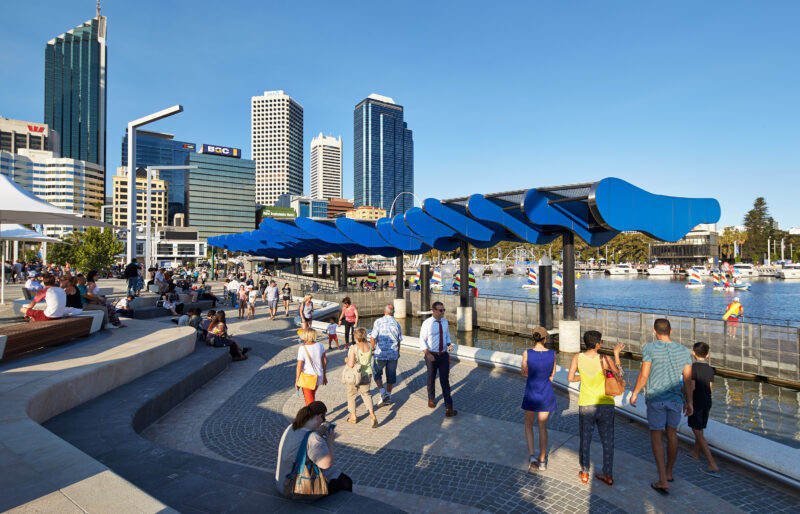
Elizabeth Quay is a remarkable example of waterfront redevelopment. Balancing the relaxed natural beauty of the river with vibrant city energy, it’s accessible and enjoyable for everyone – daytime to nighttime. Its opening ten years ago marked the first step toward creating a more vibrant and connected riverfront, and the City of Perth’s Shaping Perth City Centre – Towards 2036 and Beyond plan for the next 10 years will build on its success.
After Elizabeth Quay came Adelaide Riverfront and Queensland’s Home Of The Arts (HOTA). What ARM arguably does better than many firms is recognise that that successful precincts are social ecosystems, and culture is economic infrastructure.
We design the conditions for investment, activity and identity to reinforce each other over decades. The most successful waterfront precincts attract long-term investment because they reduce risk for investors while increasing upside.
ARM’s projects tend to do this in several ways, making the underlying place strong enough to continually attract people, businesses, and capital.
1. Create confidence through a strong masterplan
Elizabeth Quay attracts investment by creating waterfront land value. Adelaide Riverbank attracts investment by reconnecting the city with its festival and entertainment economy. HOTA attracts investment by creating cultural gravity.
Investors are wary of precincts that depend on a single building or developer succeeding. ARM’s masterplans establish the structure of the whole precinct – public spaces, movement networks, view corridors, development parcels, and key destinations – before individual projects are delivered. At Elizabeth Quay, the masterplan defined future development sites and the public realm framework that private projects would eventually occupy.
Great precincts take 10-30 years to mature, and the strength in masterplanning is designing a framework rather than finished pictures. In effect, the masterplan becomes a long-term investment platform, strong enough to guide growth but flexible enough to absorb change.

2. Generate foot traffic before development arrives
A retailer, hotel operator or office tenant is much more likely to invest in places that are already buzzing with people, activity and profile. At Elizabeth Quay and Adelaide Riverbank, major public spaces, promenades, event venues, playgrounds, and festival infrastructure draw people to the precinct independent of commercial tenants. HOTA is interesting because it wasn’t a waterfront commercial precinct first. We used culture as the investment catalyst and which is building economic activity around it.
3. Build a destination with strong local identity
Many developments fail because they are essentially a collection of buildings. ARM’s precincts are conceived as destinations with a clear identity and purpose. Driving the design of each great precinct is a single idea – pre-existing and specific to the place.
The ideas are bold, and always unique. Each emerges from place – landscape, history, culture, industry, community – which makes the local identity genuine. At Elizabeth Quay, the design draws from Noongar stories and Perth’s environmental conditions. The landscape, indigenous planting, water patterns, and public realm elements are tied to place rather than imported design trends. Adelaide Riverbank references the South Australian landscape through its public realm design and microclimate strategies.
Elizabeth Quay combines recreation, dining, events, tourism, play spaces and waterfront experiences, and we see this at HOTA, too. Adelaide Riverbank is tied directly to Adelaide’s cultural and festival economy.
Places with a genuine identity become memorable, marketable, tourism assets and civic symbols. Investors favour them: more visitors, stronger rents, better hotel occupancy and heftier brand value.

4. Leverage public investment to unlock private investment
A recurring pattern in successful precinct renewal is that governments invest heavily in public realm first, and ARM’s projects often include promenades, civic plazas, landscape infrastructure, cultural spaces, waterfront access, and event facilities.
These public investments increase surrounding land values and make private projects more viable. At Elizabeth Quay, new residential, commercial, retail and hotel developments emerged around the public framework created by the masterplan. In economic development terms, public investment acts as the catalyst.
5. Support multiple economic drivers
Precincts that rely on a single sector are vulnerable. ARM’s successful waterfront projects typically thrive because they combine culture, commerce and community. They bring together tourism, hospitality, workplaces, and events in a way that keeps the precinct constantly alive.
For example, Elizabeth Quay accommodates festivals, recreation, food and beverage venues, tourism and future commercial development simultaneously. This diversification makes investment more resilient during economic cycles.
HOTA diversifies the Gold Coast economy. It was deliberately conceived to strengthen creative industries, attract cultural tourism and diversify visitation beyond the traditional beach market, providing reasons for people to visit throughout the year. The City of Gold Coast expects the new Lyric Theatre alone to attract around 200 major touring performances annually and more than 250,000 additional visitors to the precinct, with activities consistently supporting food and beverage venues, accommodation, and retail.
6. Create a sense of permanence
Investors look for signals that a precinct will matter in 20 years, not just five. ARM achieves this through:
- major civic spaces
- strong landscape design
- cultural programming
- connections to local identity and history
- enduring public infrastructure
At both Elizabeth Quay and Adelaide Riverbank, the public realm was designed as a long-term civic asset connected to local culture and environment rather than a temporary activation project.
That permanence attracts institutional investors, super funds, hotel operators and major developer who are looking to invest over decades rather than years.
What ARM does
ARM precincts attract long-term investment because we don’t start by asking: “How do we develop this land?”
We start by asking: “How do we create a place people will love?”
Once that’s answered, investment follows.
The most successful precincts create a virtuous cycle:
Great public realm → more visitors → stronger identity → higher land values → private investment → more activity → greater economic and cultural value.
Elizabeth Quay, Adelaide Riverbank and HOTA all demonstrate this principle. They’re not successful because of any one building; they’re successful because the underlying place is strong enough to continually attract people, businesses, and capital.