Don’t scatter tenure. Instead, equalise dignity.
We need to stop treating mixed tenure – “salt and pepper” as a universal good. It produces mixed results – useful in some settings, but not inherently more ethical than other models. Sometimes mixing within in a building is right. Sometimes separate but equal buildings is right. Sometimes dedicated supportive housing is exactly what’s needed.
The best approach, argues ARM director Jesse Judd, isn’t to scatter tenure; it’s to ensure tenure equity.
Jesse was a panellist at the 2026 Affordable Housing Development & Investment Summit.
Australia’s affordable housing debate has become very good at talking about numbers. Targets. Pipelines. Subsidies. Yield. Ratios. Tenure mix.
All of that matters. Deeply. But once a project is built, residents don’t live inside a ratio. They live through a front door. They wait for a lift. They use a courtyard, or they don’t. They invite friends over, decorate a bedroom, find a quiet place for a child, navigate the laundry, the mailbox, the car park, the support worker, the neighbour, the rules.
That is where mixed tenure succeeds or fails.
At this year’s Affordable Housing Summit, I argued for a more practical test. Mixed tenure only works when tenure disappears from the resident experience – but support, care and housing need remain visible in the design brief.
This distinction matters, because the simplistic version of mixed tenure says: scatter the social, affordable and private homes throughout a development and social cohesion will follow. Salt and pepper the building. Let proximity do the work.
But proximity is not equity, and scatter is not policy.
Instead of whether tenures are randomly distributed on a plan, the better question is whether any resident is spatially downgraded by the model. Can you tell who is a social, affordable or private resident by the front door? By the lobby? By the view? By the courtyard gate? By the quality of the materials? By the maintenance regime? By who gets to use the roof terrace?
If yes, then – however elegant the tenure diagram looked in the feasibility study – the project has failed the lived-experience test.
Mixed tenure is not a ratio. It is a management model.
The hard part isn’t drawing different tenure types next to each other. The hard part is managing them over 30, 40 or 50 years. Who controls the shared spaces? Who pays for them? Who resolves conflict, provides support, benefits from uplift? \Who has a voice when rules are made?
These aren’t secondary questions; they are the project. A development can hit the numerical target yet produce an unequal place.
The best approach isn’t tenure scatter: it’s tenure equity.
Support is not stigma
A persistent mistake in the affordable housing conversation is assuming that dedicated social or supportive housing is inherently stigmatising. It can be. But not because it’s dedicated. It’s because it has been under-designed, under-funded, badly located, poorly maintained – treated as residual infrastructure rather than architecture.
Done well, dedicated housing can be beautiful, specific and profoundly empowering.
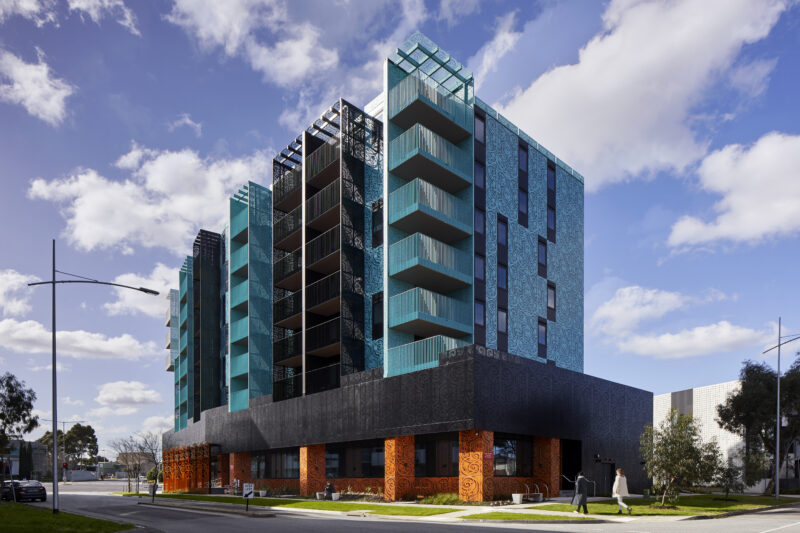
Viv’s Place in Dandenong, designed by ARM for Launch Housing, is a good example. It’s supportive housing for women and children escaping family violence. Its success doesn’t come from pretending those residents have generic needs. It comes from recognising the specificity of safety, care and family life – apartments alongside consultation rooms, children’s spaces, communal kitchen and dining, gardens and terraces. Its design language is deliberately domestic, patterned and warm. It says: this isn’t an institution; this is a home.
The crucial lesson? Equity is not sameness. Some housing should be tenure blind. Some housing must be support-visible. For vulnerable residents, scattering can dilute the services and community infrastructure that make housing work.
Bellfield, social housing designed for Launch Housing, supports the dedicated case. It brings together housing, communal lounge and dining, consultation spaces, bike storage, outdoor areas and site-specific artwork, backed by a partnership model and a long-term land arrangement. And that’s the point: good housing is not only a built asset, it’s a social contract.
A flexible building is more socially progressive than a perfectly scattered tenure diagram.
At both projects, dual-key apartment planning allows homes to adapt as households change – studios and adjoining apartments can combine into larger family accommodation, which is more a social equity device than a clever technical feature.
The same principle applies in broader mixed-tenure precincts. Tenure mix needs household mix. A serious housing model must support single people, families, children, carers, older residents, disabled residents, changing custody arrangements and different models of care.

Belonging is designed.
The best affordable housing doesn’t look apologetic, or like it was value-managed out of civic life. It has character, address and delight.
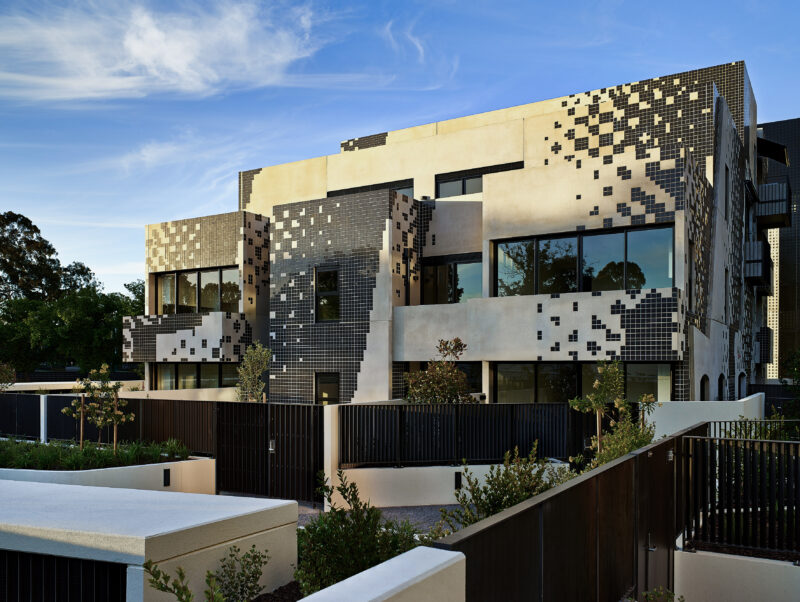
ARM’s Local and Ambient apartments in Carlton show that affordable housing can contribute genuine personality to the city. Local uses robust balconies, adaptability, park outlook, a material language tied to Carlton’s grain. Ambient gives a small building a strong civic identity through pattern, façade, local reference, wit. Character tells residents whether they are being housed reluctantly or welcomed into the life of the city.
But character alone is not enough. Good architecture cannot, by itself, overcome unequal access, weak governance or a tenure model that makes difference visible in the wrong ways.
The real test
So, let’s stop asking only: is it mixed tenure? Ask instead: Is it equitable in access? Is it generous in amenity? Is it flexible in use? Is it supported in operation? Is it managed for the long term? Can residents live there without their tenure being announced by the architecture?
Salt and pepper is a seductive diagram, but it’s not a housing policy.
The goal isn’t to scatter disadvantage more evenly, it’s to design housing where no resident is spatially downgraded, where support is available without stigma, where common amenity is genuinely shared, and where the model is built around real lives rather than abstract ratios.
Don’t scatter tenure.
Equalise dignity.