Beyond Buildings: The University as Experience
What Makes a University a Place People Choose?
Universities compete through teaching, research and reputation. But people experience them through place.
Place shapes whether students feel they belong. Whether staff want to come in. Whether researchers feel visible and connected. Whether industry and community feel invited in.
The best university projects do more than accommodate people. They give people reasons to be there.
1. Let Country lead
Place starts with what was already there. Country, culture, ecology, memory and story should shape the brief from the beginning – not arrive later as interpretation or decoration.
That changes not just how a place looks, but who it is for, how it is understood and how people belong within it.
MUNARRA CENTRE FOR REGIONAL EXCELLENCE
ARM worked with Yorta Yorta knowledge and community ambition to create a place where culture, learning, work and gathering are inseparable.

2. Keep what matters
New is not automatically better. Existing places contain carbon, memory, character and cultural value that can be lost remarkably quickly.
Good design asks what should be retained, adapted and carried forward before asking what should be replaced.
MONASH UNIVERSITY CHANCELLERY
ARM combined high environmental ambition with the selective retention of furniture, artworks and material memory from the former Chancellery.

3. Make existing places work harder
Universities already own enormous amounts of space. The opportunity is often not to build more, but to make existing places more useful, adaptable, inclusive and loved.
A strategic refurbishment can change how people use and perceive an entire building.
BAILLIEU LIBRARY, UNIVERSITY OF MELBOURNE
ARM used a whole-building strategy to guide staged renewal and create richer choices for social, collaborative and focused learning.

4. Think beyond the front door
People don’t experience buildings as isolated objects. They experience the walk there, the shortcut, the threshold, the shady seat, the active edge and the place they meet someone unexpectedly.
Every project therefore has a responsibility to improve the places around it.
ARTS WEST, UNIVERSITY OF MELBOURNE
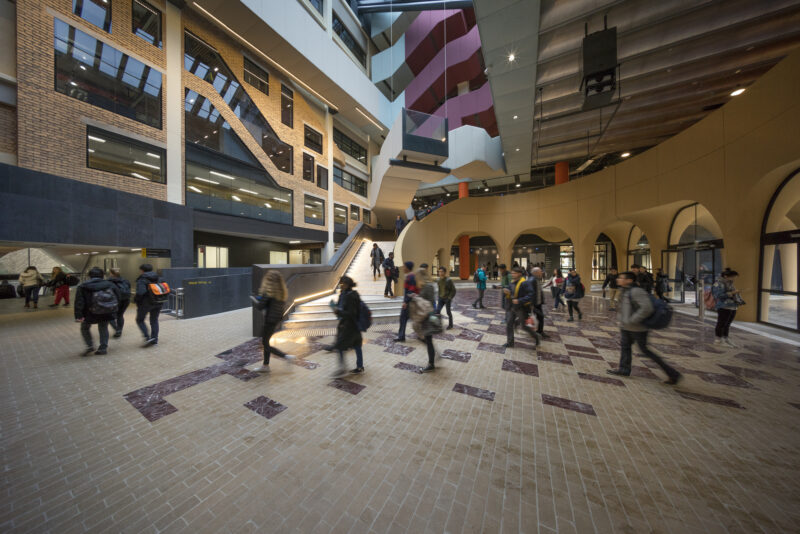
ARM designed Arts West as part of a larger campus experience, strengthening movement, gathering and connection around Professors’ Walk.
5. Let learning happen everywhere
Learning has escaped the classroom. It happens in libraries, foyers, corridors, cafés, stairs, lawns, studios and all the spaces in between.
The richest learning environments give people choice – somewhere to collaborate, concentrate, experiment, watch, talk or simply stay.
ADELAIDE UNIVERSITY LEARNING ENVIRONMENTS
Across a series of adaptive reuse projects, ARM transformed existing university spaces into flexible settings for formal and informal learning.

6. Make work worth the trip
Hybrid work has changed the relationship between people and workplace. If people can work anywhere, the workplace needs to offer something worth coming together for.
That means designing for mentoring, exchange, culture, concentration and the social energy that only proximity can create.
RMIT OURPLACE
ARM used observation and detailed workplace analysis to create places centred on collaboration, connection and purposeful presence.

7. Make wellbeing tangible
Wellbeing is not a room or a program. People experience it through daylight, acoustics, landscape, accessibility, choice, safety, dignity and the ability to find both company and retreat.
The everyday details of place can either reduce friction and anxiety – or quietly add to them.
FLINDERS MEDICAL CENTRE ACUTE SERVICES BUILDING
ARM balanced an intensely technical environment with orientation, comfort, identity and human dignity.

8. Make knowledge visible
Universities are full of extraordinary work that too often disappears behind closed doors. Place can reveal that activity and allow students, researchers, partners and the public to see knowledge being made.
Visibility builds curiosity, connection and institutional confidence.
VICTORIAN DESALINATION PLANT
ARM showed how highly technical infrastructure can become legible, civic and connected to the life of its wider landscape.

9. Create places where worlds overlap
Collaboration rarely happens because an organisation chart says it should. It happens when people encounter one another, share facilities, see what others are doing and have somewhere to continue the conversation.
Place can turn proximity into participation.
BLACKTOWN EXERCISE SPORTS AND TECHNOLOGY HUB — BEST
ARM brought sport, health, technology, education, research and community together in a shared environment built for exchange.

10. Make somewhere people want to stay
People aren’t students or employees every minute of the day. They eat, meet, exercise, rest, travel, socialise and form attachments to the places around them.
The more complete the experience, the more likely a place is to build community rather than simply process occupants.
REALM CAULFIELD
ARM’s work demonstrates how housing, amenity and public realm can create a richer place to live, work, learn and belong.

Place is the experience
None of these 10 moves is a separate idea; they overlap.
Country shapes identity. Reuse carries memory forward. Learning spills into public space. Workplace supports culture. Wellbeing depends on everyday experience. Visible research creates new connections. Housing and amenity turn institutions into communities.
The common thread is simple: place matters because people matter.
The best university projects do more than add floor area. They make institutions more attractive to students, more compelling to staff, more visible to partners, more connected to Country and more valuable as places.
That is the opportunity for every university project: not simply to make more space, but to make a place people choose.